

Crookes tubes
The fourth page, radiant matter tubes.
The fourth page, radiant matter tubes.


The Crookes Y tube (Crookes nr 6)
Demonstrates that the electrons go in a straight
line and won't go through the bend following the
negative pole.
Demonstrates that the electrons go in a straight
line and won't go through the bend following the
negative pole.

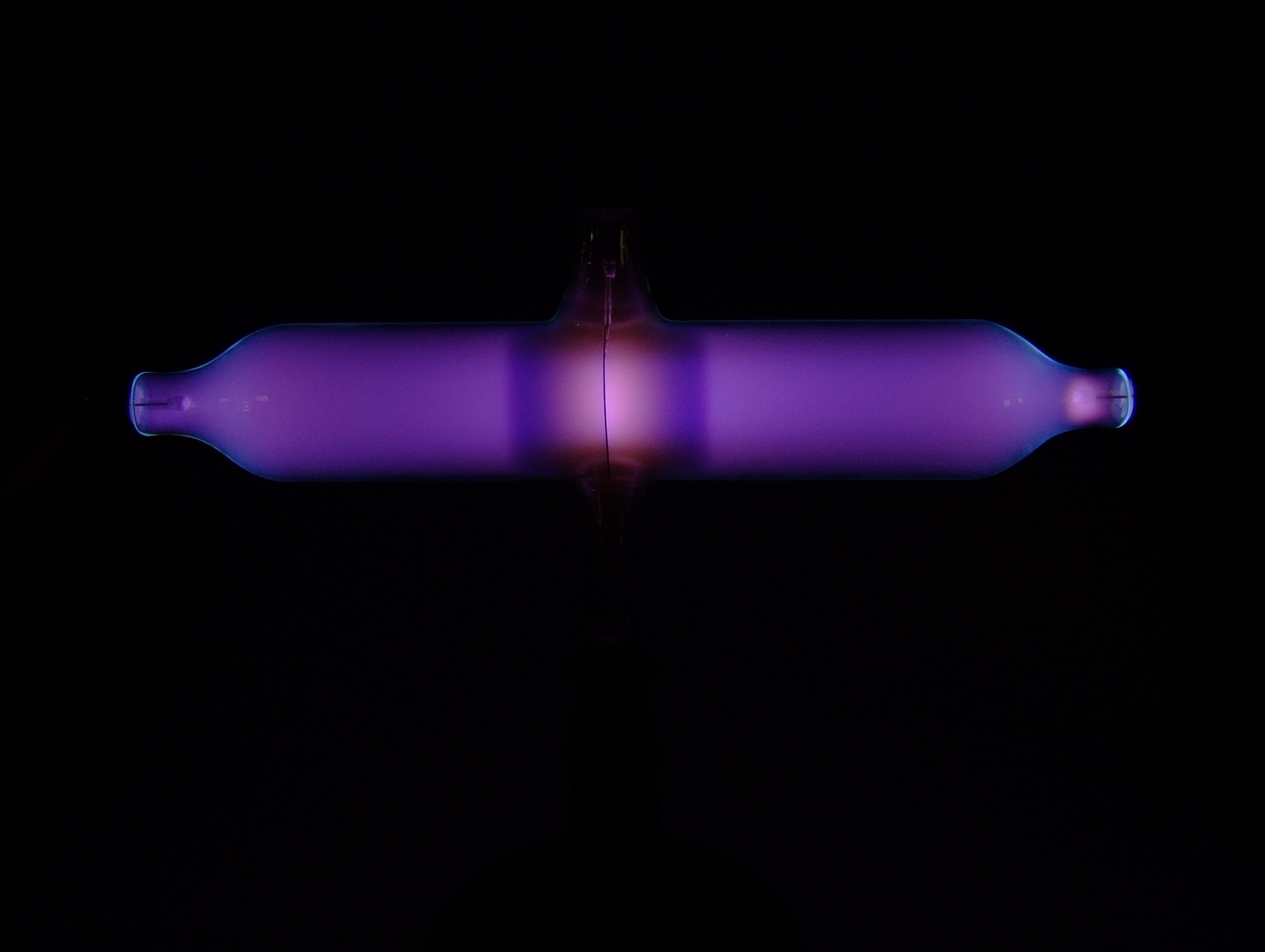
Crookes dark space tube
made by Pressler
made by Pressler
activated dark space tube
The Crookes dark space tube (Crookes nr 1)
Shows the dark space on the left and right side of the
round metal plate in the middle of the tube. In this case
the metal plate must be negative and the two side
electrodes must be connected to the positive side of the
source. The size of the dark space depends on the
amount of pressure (vacuum).
Shows the dark space on the left and right side of the
round metal plate in the middle of the tube. In this case
the metal plate must be negative and the two side
electrodes must be connected to the positive side of the
source. The size of the dark space depends on the
amount of pressure (vacuum).
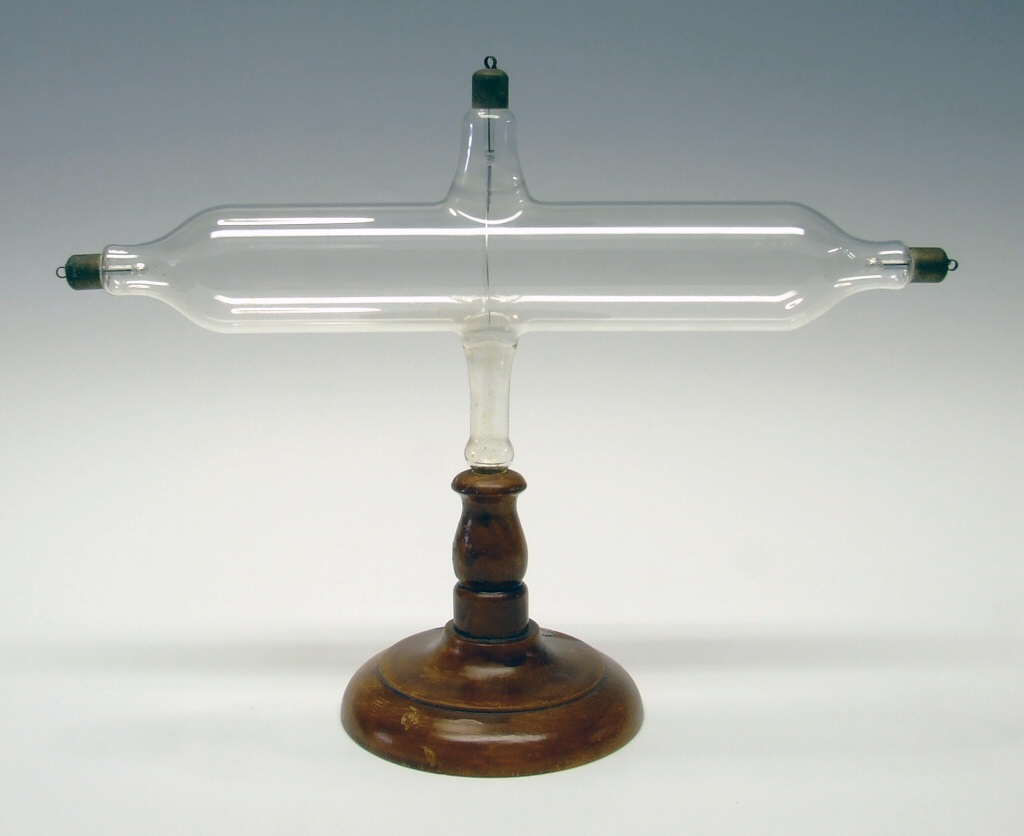

An early made Crookes dark space tube made before 1900 with blue glass seals.
Two very early Crookes tubes.
With envelope diameters of about 6 centimeters, one with metal electrodes, the other with pyramidal shaped carbon electrodes. The tube with the small ball electrodes is a tube with an absolute vacuum, there is no glow or spark in the tube even with very high voltage, that, even after all those years! Darkening on the glass suggests restoring the vacuum due to heat in the past.
The other tube has some gas molecules which will give a discharge when activated, the odd electrodes are still a mystery.
With envelope diameters of about 6 centimeters, one with metal electrodes, the other with pyramidal shaped carbon electrodes. The tube with the small ball electrodes is a tube with an absolute vacuum, there is no glow or spark in the tube even with very high voltage, that, even after all those years! Darkening on the glass suggests restoring the vacuum due to heat in the past.
The other tube has some gas molecules which will give a discharge when activated, the odd electrodes are still a mystery.
Activated tube


The "gassy tube" has strange electrodes.

The Crookes heating effect tube (Crookes nr 21)
Shows the effect of a stream of electrons creating
heat when they hit a platinum foil.
Shows the effect of a stream of electrons creating
heat when they hit a platinum foil.


Early Crookes uranium glass discharge tube .
Length 15cm
Length 15cm
Tube under UV, in working order it must have looked like this.
Crookes discharge tube (Crookes nr 2) which was sold
by three or five the same models but with different sorts of glass
like Didym, uranium or lead glass which fluorescence
different colors, like: green, blue-white, blue, red and yellow.
by three or five the same models but with different sorts of glass
like Didym, uranium or lead glass which fluorescence
different colors, like: green, blue-white, blue, red and yellow.

Activated railwaytube
Click for a larger picture
Click for a larger picture
The Railway tube (Crookes nr 11)
The electrons bounced at the paddles covered
with a small amount of phosphor will turn
the paddlewheel and move from one to the other
side of the tube. In fact it is the heat which is
present when the electrons strike the vanes that
turns the peddle wheel similar as the Radiometer.
Several scientists like Maxwell and Puluj stated
this although Crookes was convinced of the
electron force theory. Eventually it was Thomson
who proved that the electron force in the tube
necessary to move the wheel was insufficient.
The electrons bounced at the paddles covered
with a small amount of phosphor will turn
the paddlewheel and move from one to the other
side of the tube. In fact it is the heat which is
present when the electrons strike the vanes that
turns the peddle wheel similar as the Radiometer.
Several scientists like Maxwell and Puluj stated
this although Crookes was convinced of the
electron force theory. Eventually it was Thomson
who proved that the electron force in the tube
necessary to move the wheel was insufficient.


Here a drawing from the Deschanel 1869 Physics book describing the absolute vacuum tube as a perfect isolator.Also known as Hittorf tube.
Notice the similar electrodes.
Notice the similar electrodes.
Early Crookes Y tube
made last quarter of the 19th century
made last quarter of the 19th century


The Crookes mill tube (Crookes no 17)
This tube has several names, in German wasserrad
röhre or mühl röhre which means water mill tube or
mill tube, in English sometimes paddle wheel tube.
The wheel will turn clock or counterclockwise
depending on the magnet poles which deflects the
electron beam to the vanes.
This tube is made before 1899 by the French maker
Radiguet in Paris as stated on the label.
When Massiot joined the firm in 1899 it became
known as Radiguet & Massiot. The store was located
on Rue des Filles du Calvaire in the center of Paris.
This tube has several names, in German wasserrad
röhre or mühl röhre which means water mill tube or
mill tube, in English sometimes paddle wheel tube.
The wheel will turn clock or counterclockwise
depending on the magnet poles which deflects the
electron beam to the vanes.
This tube is made before 1899 by the French maker
Radiguet in Paris as stated on the label.
When Massiot joined the firm in 1899 it became
known as Radiguet & Massiot. The store was located
on Rue des Filles du Calvaire in the center of Paris.

The storefront of Radiguet in Paris.

Crookes Y tube.
made by Müller Uri early 20th century.
made by Müller Uri early 20th century.
Activated arms of the tube.
Crookes mill tube
made by Radiguet end of the 19th century
made by Radiguet end of the 19th century


Early 1900 Crookes no21
Heating effect tube
Maker Müller-Uri (reference collection Harvard University)
Heating effect tube
Maker Müller-Uri (reference collection Harvard University)
Close-up of the platinum foil
Early Crookes no21
Heating effect tube
first quarter 20th century.
Maker Müller-Uri (reference collection Harvard University)
Heating effect tube
first quarter 20th century.
Maker Müller-Uri (reference collection Harvard University)


Heating effect X-Ray tube height 42cm
This tube sold by Kipp & Zonen ca 1920 was also used as a demonstration x-ray tube.
Probably produced by Emil Gundelach Germany.
The axis of the foil foil has an angle of 45 degrees which was perfect for classroom X-ray demonstrations.
This tube sold by Kipp & Zonen ca 1920 was also used as a demonstration x-ray tube.
Probably produced by Emil Gundelach Germany.
The axis of the foil foil has an angle of 45 degrees which was perfect for classroom X-ray demonstrations.

The platinum foil


Early E/M tube after Wehnelt ca 1920
This rare tube was used for demonstrating the curving of the cathode ray by a magnet and as a substitute for the classic Thomson E/M tube with an Helmholtz coil. The oxide cathode produced a fine cathode ray beam. There are only six types of Wehnelt tubes known. Look here.
This rare tube was used for demonstrating the curving of the cathode ray by a magnet and as a substitute for the classic Thomson E/M tube with an Helmholtz coil. The oxide cathode produced a fine cathode ray beam. There are only six types of Wehnelt tubes known. Look here.
These tubes used the first hot cathode
filaments developed by Wehnelt in 1904.
In fact there is a small dot of rare earth
oxide in the center of the platinum foil
which was heated by a small voltage.
Due to this invention the voltages for
using these tubes could be dropped to
a few hundred of volts in stead of
thousands like most Crookes tubes.
filaments developed by Wehnelt in 1904.
In fact there is a small dot of rare earth
oxide in the center of the platinum foil
which was heated by a small voltage.
Due to this invention the voltages for
using these tubes could be dropped to
a few hundred of volts in stead of
thousands like most Crookes tubes.
The Oxide Filament
Early Crookes railwaytube
Length 32cm ca 1900
Length 32cm ca 1900


Like it? Sign the Guestbook!


Another early Crookes mill or wasserrad tube
Length 30cm ca 1900
Length 30cm ca 1900

Activated tube
click for a larger picture
click for a larger picture


A piece of Crookes Radiometer History
William Crookes (interested in spiritualism) did many experiments with the medium Daniel Douglas Home next to al his other physics work.
Crookes was so fascinated that he, as a scientist, wanted to measure this "new force". He believed that every human must have this
kind of physic force. Crookes developed a sensitive "indicator" in order to work without (the strong force of) D.D. Home, in fact this was the
beginning of the radiometer. He had some information from James Emerson Reynolds professor of the Royal Dublin Society who had
constructed a little instrument which would turn to the hand, fire, or another source of heat. [It consisted of a thin slip of deal suspended by a
filament of spiders web and enclosed in a thin glass flask.....] all of this in 1871. After this experiment Crookes was so obsessed by this
newly discovered phenomenon that he soon constructed many types of radiometers, otheoscopes and did great research of the behavior in
vacuum to eliminate the resistance of air molecules.
In 1876 Crookes assistant Charles Henry Gimingham, a skilled glassblower produced for the physicist William Grove the first electrical
radiometer with metal vanes which Crookes developed further into the yet well known form. Geissler however, made better evacuated tubes
due to his self developed vacuum pump which irritated Crookes, his produced electrical radiometers glowed faintly due to residual gas.
This was the start of a new race to produce the perfect vacuum sealed in glass. Crookes patented his radiometer on 5 Nov 1875 under patent
number GB 3860. On 13th of May 1876 the Queen opened the Special Loan Exhibition in London, where both Crookes and Geissler showed
there radiometers to the public. William Crookes presented here also his flask with "nothing" (vacuum tube) in which the Queen was not
interested....
Source: Gasentladungsforschung im 19 Jahrhundert by Falk Müller.
The radiometer invented by William Crookes in 1875 stood at the base of his later developed railway tube. The four vanes are spinning in a
glass envelope with a pressure of 1 Torr, when exposed to light the vanes turn. Due to heating of the vanes which are black on one side there
is movement, this is called thermal creep. The black side of the vanes are a little hotter than the silver side so the gas molecules pushing to
the black side turning the vanes. It's successor is the electrical radiometer (Crookes nr 12)
Look here and here for a great collection from the past.
William Crookes (interested in spiritualism) did many experiments with the medium Daniel Douglas Home next to al his other physics work.
Crookes was so fascinated that he, as a scientist, wanted to measure this "new force". He believed that every human must have this
kind of physic force. Crookes developed a sensitive "indicator" in order to work without (the strong force of) D.D. Home, in fact this was the
beginning of the radiometer. He had some information from James Emerson Reynolds professor of the Royal Dublin Society who had
constructed a little instrument which would turn to the hand, fire, or another source of heat. [It consisted of a thin slip of deal suspended by a
filament of spiders web and enclosed in a thin glass flask.....] all of this in 1871. After this experiment Crookes was so obsessed by this
newly discovered phenomenon that he soon constructed many types of radiometers, otheoscopes and did great research of the behavior in
vacuum to eliminate the resistance of air molecules.
In 1876 Crookes assistant Charles Henry Gimingham, a skilled glassblower produced for the physicist William Grove the first electrical
radiometer with metal vanes which Crookes developed further into the yet well known form. Geissler however, made better evacuated tubes
due to his self developed vacuum pump which irritated Crookes, his produced electrical radiometers glowed faintly due to residual gas.
This was the start of a new race to produce the perfect vacuum sealed in glass. Crookes patented his radiometer on 5 Nov 1875 under patent
number GB 3860. On 13th of May 1876 the Queen opened the Special Loan Exhibition in London, where both Crookes and Geissler showed
there radiometers to the public. William Crookes presented here also his flask with "nothing" (vacuum tube) in which the Queen was not
interested....
Source: Gasentladungsforschung im 19 Jahrhundert by Falk Müller.
The radiometer invented by William Crookes in 1875 stood at the base of his later developed railway tube. The four vanes are spinning in a
glass envelope with a pressure of 1 Torr, when exposed to light the vanes turn. Due to heating of the vanes which are black on one side there
is movement, this is called thermal creep. The black side of the vanes are a little hotter than the silver side so the gas molecules pushing to
the black side turning the vanes. It's successor is the electrical radiometer (Crookes nr 12)
Look here and here for a great collection from the past.

Crookes radiometer

Very early radiometer
last quarter 19th century
last quarter 19th century


A rare Zöllner double radiometer tube
Drawing of a Zöllner double
radiometer tube Max Kohl 1905
radiometer tube Max Kohl 1905
Explanation of the working of this tube is
described by Zöllner and Puluj in Annalen der
Physik in 1877 but it's difficult to understand and
cryptic. In basic, if a low voltage ~2 Volts is
applied to the Platinum and Aluminum wire
beneath the mica vanes they turn clock and anti-
clockwise.
The tube is evacuated to a high vacuum so there
is no normal thermal airflow to rotate the vanes.
This tube has a great similarity with the Crookes
tube no13.
described by Zöllner and Puluj in Annalen der
Physik in 1877 but it's difficult to understand and
cryptic. In basic, if a low voltage ~2 Volts is
applied to the Platinum and Aluminum wire
beneath the mica vanes they turn clock and anti-
clockwise.
The tube is evacuated to a high vacuum so there
is no normal thermal airflow to rotate the vanes.
This tube has a great similarity with the Crookes
tube no13.
Close-up of the vanes and wires


A very rare double radiometer ca 1880 French origin.
This tube demonstrates the behavior of the difference between the blackened vanes and the clean ones. the blackened vane will turn when illuminated, the clear one not.
In Nature 1876 we can read that Alvergniat Freres build a tube to demonstrate the weakness of the blank vanes.
This could be a tube made by this company
This tube demonstrates the behavior of the difference between the blackened vanes and the clean ones. the blackened vane will turn when illuminated, the clear one not.
In Nature 1876 we can read that Alvergniat Freres build a tube to demonstrate the weakness of the blank vanes.
This could be a tube made by this company
The glassblower craftsmanship is wonderful.

Darkspace tube ca1880-1900
This tube has a potash regulator to regulate the vacuum. This regulator could be heated lowering the vacuum to show the change of the discharge in the tube.
This tube has a potash regulator to regulate the vacuum. This regulator could be heated lowering the vacuum to show the change of the discharge in the tube.

Early 1900 V tube English origin
The Cathode Ray Tube site
150 years of CRT evolution
The Dutch collection
150 years of CRT evolution
The Dutch collection

HOME
CRT
X-ray
tubes
tubes
Geissler
tubes
tubes
Crookes
tubes
tubes
Induction
coils
coils
Camera
tubes
tubes
Info
page
page
Second
page
page
Third
page
page
Fourth
page
page
Glass
blowers
blowers
Traders
Tube
info
info

Crookes electrical radiometer ca1920